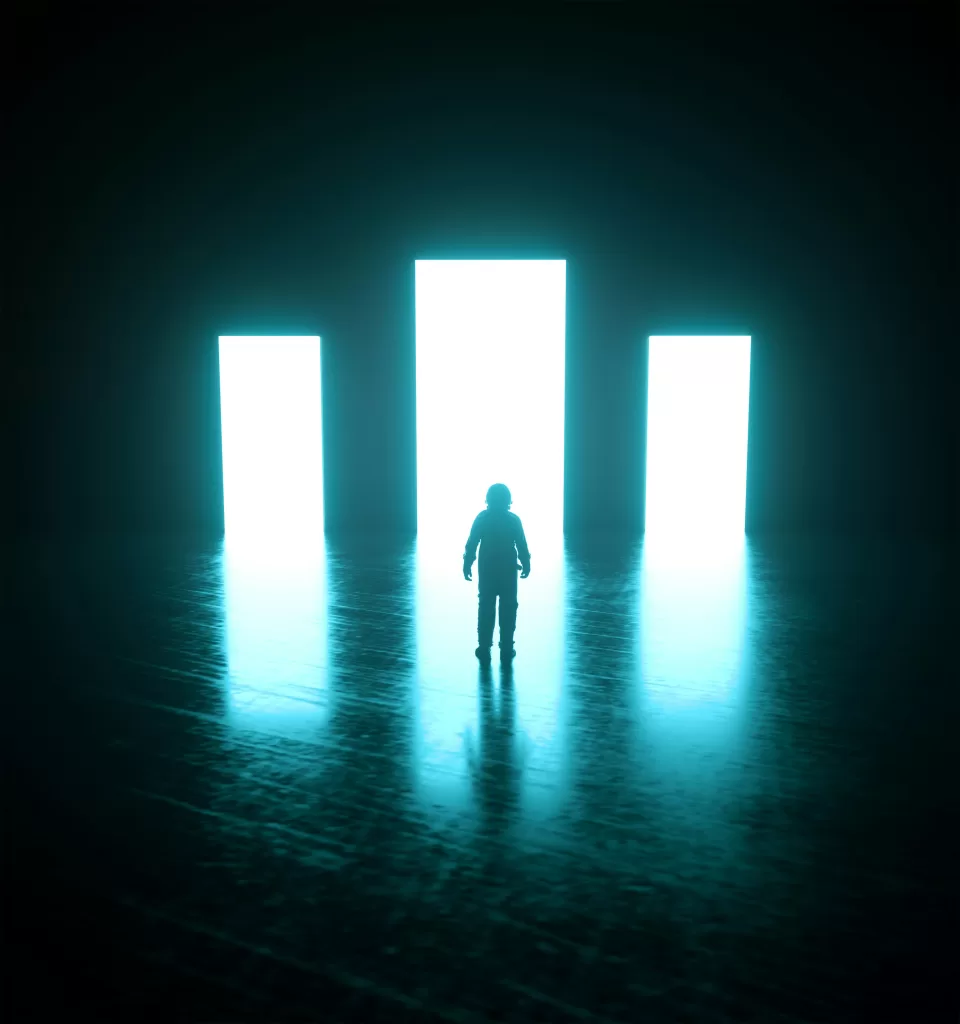
How many stories could come from one language, how many verses before we exhaust its meaning? Our universe is but one verse flowing from the language of possibility. Our actual world has not exhausted the dimension of what-could-be. Humans are uniquely drawn to this dimension, invited to leap into the world of not-yet. Intuition and imagination show the way, and what we find in this other-worldly dimension are the most delightful creatures: Beautiful bundles of possibility desiring to make their way back with us, to the land where they may find flesh – actual existence; harmonies of values seeking embodiment.
Think of your own life – how much of your thoughts and energy are engaged with the past, and how much is occupied with the future? Of course, it can’t be accurately measured for most of it happens unconsciously, but the way in which our occupation with the past manifests is in feelings of missed opportunities, disappointments, regrets – or gratitude and a sense of wisdom gained. The way we feel the future is through anxiety, fear, or excitement and joyful anticipation. Reality is two-sided: Actuality is the story that brought us here, and possibility is what draws us forward. Possibility might not be as obviously real as actuality, but it is real nonetheless, for nothing could actually exist if it were not possible.
So much of our culture and technology keeps us occupied with the actual world. There are many ways of shuffling the components of what exists to produce something new. However, the most exciting and valuable novelties do not come from rearranging what is; rather, by reaching into the not-actual world, the world of possibility, we may find something that has never been before. We have the capacity to escort these unique bundles of possibilities through this journey of incarnation, to find a body, and become actual.
Divine Detachment.
To make the journey to the world of possibility requires some degree of detachment from what is actual. Imagination provides a path to this realm, but there are many detours. Creative imagination is not the same as entertainment. We may be entertained by watching a movie – someone else’s imagination made visible – but that doesn’t require much creativity. To truly engage our creative imagination is an intense and unique journey. It most often requires detaching from distractions, even detaching from your physical senses. Various practices of meditation and prayer have been developed for this very purpose, to reduce our feeling of what is actual and increase our feeling of what is possible.
This kind of practiced detachment is not an escape from our world, but a revitalizing of its essential source. Practices such as meditation and prayer are ways of detaching from the temporal so that we may connect more intensely with eternal values … so that these values may find a way into our actual world and transform it. The detachment is not permanent; rather, it is part of an incarnational rhythm in which Logos becomes flesh, and flesh becomes Logos as envisioned by the author of the gospel of John. Values in the mind of God find opportunity to become actual in us, and we find opportunity to participate in the eternal mind of God.
Creative Tension
In the previous article of this series, we saw, amongst other things, how both experience and understanding are interpretations of our world, and these interpretations overlap. Understanding is a type of experience, and experience is a type of interpretation. We also considered the fact that we all operate with a personal “ontology”—a framework of understanding, mostly unconscious, that tells us what is real.
It’s not controversial to state that we develop habits of thought, and our ways of thinking affect our experiences. Habits can be beneficial, but they can also devolve into boringly predictable patterns that keep us from new and valuable experiences. The future does not have to be a repetition of the past. More is possible! Experience is an act of interpretation, and interpretation harmonizes both actualities and possibilities. There is a creative tension between all we have experienced before and all we have not experienced yet.
We can contemplate ideas that are not actual. This morning, neither Mary-Anne nor I have any set appointments. I’m considering going for a cycle with her on a new mountain cycle path we heard about, and then having a coffee at our favorite spot afterwards. The idea is not actual – it hasn’t happened – yet it is real enough to influence my actions, and consequently, make it happen. Our world is filled with actual things that began as possibility-filled ideas.
Possibilities have a relational structure. Clusters or bundles of possibilities would be a more accurate description. The possibility of cycling with Mary-Anne is intertwined with the possibility of getting to the location, being well enough to do the cycle, etc. This whole bundle of possibilities can be compared to the possibility of simply staying home and continuing the research work I’m busy with. And this comparison introduces another significant concept: possibilities are structured according to value. Some possibilities have greater value than others, and thus the structure takes on the form of a hierarchy.
Intensified experience.
The distinction between actuality and possibility is significant in helping us understand every act of interpretation. Every experience is a harmonization of the influences of the actual world and possibilities of meaning. More complex centers of experience have a greater bandwidth for possibilities. An animal has more options available to it than a plant because, for instance, it has a wider range of movements available to it. One of the distinctive characteristics of being human is the complexity of our consciousness. This complexity is directly related to the quantity of aspects we are capable of harmonizing in every act of experience. A wider range of possibilities intensifies experience.
This intensification and complexification of experience requires an openness to possibility, a vulnerability to let go of what we know and allow the unknown in. Vulnerability denotes both intimacy and danger. This vulnerability—this openness to the unknown—is an ancient theme, one that humanity has wrestled with since our very beginnings, as seen in the story of Genesis. This origin story intuitively explores the very matters that made us human and holds some key insights.
Genesis 2 ended with these words:
[T]hey were both naked (arôm), the man and his wife, and were not ashamed.
Chapter 3 begins with:
Now the serpent was more wise (arÛm) than any beast of the field which the Lord God had made.
Divisions such as chapters and verses came as a much later invention, and so the connection for ancient readers, between arôm, (nakedness) and arÛm (wisdom), would have been even more obvious. A more common noun for wisdom would have been “hkm” (חכם). But the author artfully draws our attention to the connection between nakedness and wisdom by using the less common word arÛm. In other instances, arôm is used to describe vulnerability. Wisdom, too, requires a certain vulnerability, an openness to new ideas and suggestions. Wisdom is the ability to make sound judgments, and to do that requires the ability to differentiate between values. Enters the tree of the knowledge of good and evil.
The Lord God took the man and put him in the garden of Eden to till it and keep it. And the Lord God commanded the man, saying, “You may freely eat of every tree of the garden; but of the tree of the knowledge of good and evil you shall not eat, for in the day that you eat of it you shall die.” (2:15-17 RSV.)
Richard Friedman, in his Commentary on the Torah, says the following:
Not good and “evil,” as this is usually understood and translated. “Evil” suggests that this is strictly moral knowledge. But the Hebrew word has a much wider range of meaning than that. This may mean knowledge of what is morally good and bad, or it may mean qualities of good and bad in all realms: morality, aesthetics, utility, pleasure and pain, and so on.
The tree of the knowledge of better and worse is a striking image of the value-based hierarchy of possibilities. In philosophy, we use the word axiology to refer to the study of values and their relationships. An example of child development would be helpful.[1] Before the development of an independent self, the child is immersed in their reality in such a way that there is no separation between themselves and their world. Consequently, there are no value judgments. Things just are the way they are. To make judgments about good and bad, an independent will, a judge, is necessary. Although such independence might be desirable, the development of self-consciousness will also introduce the consciousness of death. If there is no self to preserve, there is no death to fear. We have often interpreted the pronouncement “for in the day that you eat of it you shall die” as a warning of punishment, but it could equally be read as a prophetic statement of the inevitable: Self-consciousness will open the door to death-consciousness. It is partaking of the tree of the knowledge of better and worse, this development in consciousness, that inevitably results in an awareness of death.
The Genesis origin stories can be read as a mythical exploration of what makes us human. The uniqueness of our human consciousness, the intensities of desire, and the tree of axiological knowledge all contribute to our becoming. In this story, we grasp for the fruit before we are ready for it. But it becomes clear (3:22) that partaking of the tree is not evil in itself, for God partakes of this knowledge; rather, it’s the means by which we partake that can be harmful.
Leaping into the world of possibility should be a relational adventure. Like young children, we need to grow and develop the capacity to bear the responsibility of what we find there. For as humans have demonstrated throughout history, we are both clever enough and stupid enough to destroy ourselves and our world. We would greatly benefit from finding a guide in this labyrinth, one who has traversed this dimension of possibility before us and knows the way towards beauty. We can envision God as the one who “reveals the deep and secret things; He knows what is in the darkness, and the light dwells with Him!” (Daniel 2:22)
This God, knowing all that is possible, sees what is most valuable and beautiful.[2] In relation to each of us, they (God) are able to present us with the most relevant possibilities to guide us towards a meaningful life. Your very existence is part of the process in which bundles of possibilities find embodiment. What a privilege to participate in this ongoing creative process of imagining possible values and making them actual values, of introducing novelty into our world.
[2] Whitehead wrote: “The teleology of the Universe is directed to the production of Beauty.”


