It was between Christmas and New Year, summer in South Africa, that a group of friends and I started a two-day hike in a remote, mountainous area. Nature, in its raw and wild beauty, always contains surprising encounters. We carried all our gear – food, tents, etc. – and the terrain was rough. The first day was a tough nine-hour hike, but it was more than sweat and exertion. An idyllic mountain pool, deep enough to swim in, was an irresistible find just before noon. As I took my hiking boots off and immersed them in icy water, it felt as if my feet could speak, shouting “thank you!” When we found a second such pool in the late afternoon, we did not even have to make a decision – our clothes just came off unconsciously for a refreshing swim. The last two hours were the most challenging as we climbed up a steep portion of the mountain. We found a suitable space for spending the night, made a fire, cooked, and thoroughly enjoyed a well-deserved meal. With full tummies and weary bodies, the conversation soon faded, and each of us went in search of some level ground and soft grass to pitch our tents.
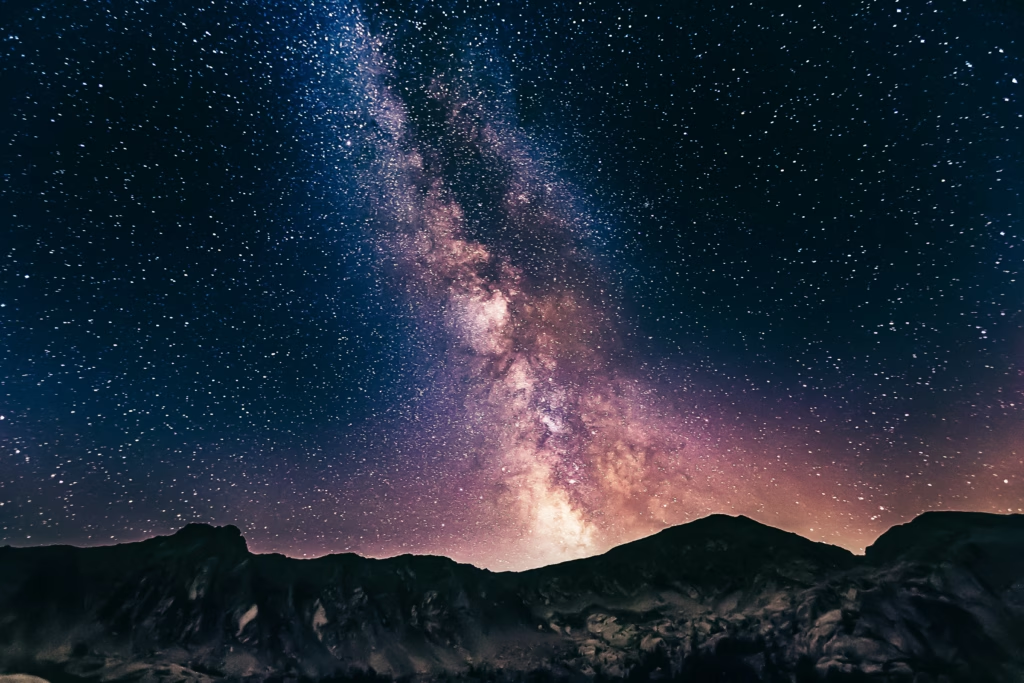
As the sun set over the mountain tops, the heavens came alive. There were no towns or sources of light anywhere near, and the moon was dark, allowing the heavens to shine without distraction. Surprisingly, for this area, there was no wind, so I decided not to pitch my tent but to simply crawl into my sleeping bag, a little distance away from the others, and enjoy the unhindered view. Throughout human history, this experience of gazing at the heavens has been a source of wonder and imaginative inspiration. Myths were written and pictures were drawn as we contemplated their meaning and connected the dotted stars.
I am not alone…
Lying on my back, soaking in the Milky Way, a nostalgic memory came to me. As a child, I lived in a rural area, and on occasions, we would camp out in the wild, make a fire, and this feeling of awe would come over me as the heavens reached through my eyes and gripped my heart. I could feel them reaching into me again.
But then, something new, something deeper began to unfold. I am gazing at the heavens, but I am not alone. In the utter silence, the rustle of a gentle breeze over the wild grass announces the arrival of a multitude. Ancient individuals, various tribes, and communities from all ages join me in gazing up into the heavens and experiencing this same awe through my eyes. Some experiences are too primordial to belong to us exclusively – they are common spaces into which we are invited. And that is what I become aware of – an invitation into divine memory. In the memory of God, nothing and no one is dead or static.[1] Everything lives – even the past drifts into the present on the gentle waves of divine thought.
As I experience this moment of profound appreciation, it’s as if everyone who has ever had this experience still lives within it. There is a center of experience more real than my subjective view. It’s not an experience I produce, but rather an experience I’m invited to participate in. A larger subjectivity, a universal consciousness, is hosting me and welcoming me into a space that I do not own, but where I belong. The heavens belong within this consciousness. I’m no longer gazing at stars far away; I’m participating in their existence, expanded into an awareness in which all things are part of one living body.
The boundaries of my individual consciousness continue to dissolve. The filter that limits awareness is lifted, and I am joined, not only by multitudes of human communities, but by every living thing. I can sense the blades of grass reaching for the water in the soil as it expresses this yearning to live. I feel the divine desire for life, for existence, in every bug as it consumes the grass. To experience God is not to experience an entity amongst other entities, but to experience the essence of all things. Everything is saturated with desire, with an urge to live towards beauty, with divine presence glowing in its depths.[2]
I fell asleep enfolded in the company of the multitudes and multiplicity of presences that dwell in the unity of divine experience.
Present in another.
As I reflected on the experience in the days that followed, I recalled the reference to a “cloud of witnesses” in the book of Hebrews. It speaks of those who have passed on before us. In chapter 11, it takes this thought even further. After talking about all the heroes of faith, it concludes:
And all these, having obtained a good testimony through faith, did not receive the promise, God having provided something better for us, that they should not be made complete apart from us. (verse 40)
Those who went before us are not made complete apart from us! A connection remains! There is a depth of experience in which time is not measured by minutes and hours, but rather, by awareness. In this space, processes that might seem to have come and gone are still in flux. Just as Moses and Elijah conversed with Jesus on a mountain top, the usual logic of who’s alive and who can still converse ceases in this absurd moment. From a physical perspective, people lived and died. From this deeper cosmic consciousness, these personal processes are not complete – they live still, and are being completed by their ongoing conversation with us.
I also remembered the writing of philosopher A.N. Whitehead: “The philosophy of organism is mainly devoted to the task of making clear the notion of ‘being present in another entity.’”[3] And another philosopher, Judith Jones, developed the idea of “‘ecstatic individuality’, which asserts that an entity exists with the ontological status of its subjectivity to some degree in every subject in which it comes to have an influence”.[4]
Poets, philosophers, and mystics have searched for words to describe this experience of being part of everything and everything being part of us.
Whitehead’s vision of God also came to mind. He wrote:
“[God] is the lure for feeling, the eternal urge of desire. His particular relevance to each creative act, as it arises from its own conditioned standpoint in the world, constitutes him the initial ‘object of desire’ establishing the initial phase of each subjective aim.”
In this passage, Whitehead articulates his concept of God as a persuasive force. God provides the initial “aim” or “desire” for every new event in the universe. This desire aims toward beauty and intensified experience; it is a “lure” that guides each occasion’s self-creation, while still leaving it free to choose its own path.
These beautiful ideas were no longer just interesting theories to me; they had become intense, mystical experiences. Our thoughts are meant to draw us into living experiences, rather than remaining isolated oddities. Similarly, our experiences are meant to inspire new insights, rather than remaining unexpressed feelings.
In solitude, I lie and look.
A space unfolds within.
Heavenly multitudes rush to fill this holy place,
for here, they may live again,
and in me, find their face complete.
Appreciation ignites their resurrection
In solitude, I’m not alone.

Alive again in divine experience -
the fadeless awe that sees the world most truly.
Alive again in Christ’s consciousness -
the fadeless awe that sees the world most truly.
The language of appreciation and poetry is the most flexible form to clothe such living experiences. In next week’s essay, I’ll slightly shift towards the language of explanation to show that these words describe more than fantasy. These experiences of divine union are unveiling the very nature of reality.
[1] As Jesus once said: “God is not the God of the dead, but of the living.” Matthew 22:32.
[2] Teilhard Du Chardin called it “the Divine radiating from the depths of blazing Matter.” in The Heart of Matter.
[3] Whitehead, Alfred North. Process and Reality (Gifford Lectures Delivered in the University of Edinburgh During the Session 1927-28) (p. 50). Kindle Edition.
[4] Jones, Judith A. Intensity, An Essay in Whiteheadian Ontology. (Vanderbilt University Press, 1998) p. xii.


